It's been about a year since I originally watched The Private Life of Plants, and now I'm watching it all over again. One of my absolute favorite scenes decribes the natural history of the Strangler Fig. Take it away Sir Attenborough:
Saturday, July 24, 2010

Monday, July 5, 2010
Half blind, half death, with 1/4 human reaction time.
Monday, June 28, 2010
Time to find Gelastocoris oculatus!
Recently on my walks around riparian areas in central Texas I've noticed tons of tiny toads, but as of yet, no Gelastocoris oculatus. The Big-Eyed Toe Bug has been on my list for several years, but for some reason I've never been in the right place at the right time. Superficially these funny little bugs resemble toad-lets, but it is hard to imagine they are gaining much benefit from this appearance. Some might suspect that Gelastocoris mimic toads because of the toxic secretions amphibians posses, but I can't wrap my head around the idea that this entire genus would be forced to adopt a certain gestalt for the sake of avoiding a few visually guided predators. In any case, I'll be watching for a toad that isn't really a toad.


Wednesday, June 2, 2010
One Year Later, Coccinella novemnotata
About a year ago, my friend Ellen Woods took a picture of the increasingly rare Nine-Spotted Ladybug, Coccinella novemnotata. Once the most common native coccinellid, I believe this species is now extinct from large swaths of North America. At the time the photo was taken, only 13 captive specimens were known in the world. Dr. John Losey and I had just collected all of them in rural Oregon thanks to The Lost Ladybug Project. Ellen's photos made big news, and not long after Nine-Spotted Ladybugs began hatching in New York (where they are the state insect!) for the first time since the 1980s. Since I was watching the first clutch of eggs endlessly, I was lucky enough to capture that Kodak moment, below.


Monday, May 17, 2010
Tuesday, May 11, 2010
Largest Living Earthworm...that we KNOW of!
Feeling like you don't know enough about the Giant Gippsland Earthworm? Let David Attenborough teach you everything you need to know!
Sunday, May 2, 2010
Larger Pygmy Mole Grasshopper?
Neotridactylus apicialis is one weird looking grasshopper from the family Tridactylidae. Not much information is available on these guys, but their morphology suggests they spend a significant amount of time under ground. And they must be larger than Neotridactylis archboldi, the plain old pygmy mole grasshoppers. N. apicialis appear to have converged on a similar morphology as the Mole Crickets. The genus Ellipes is a close relative which I recently found on the sandy banks of a medium sized stream- their standard habitat. Amazingly tiny, they were still accomplished jumpers.

Image:http://mississippientomologicalmuseum.org.msstate.edu/images/Tridactylidae/Neotridactylis.apicallis.jpg
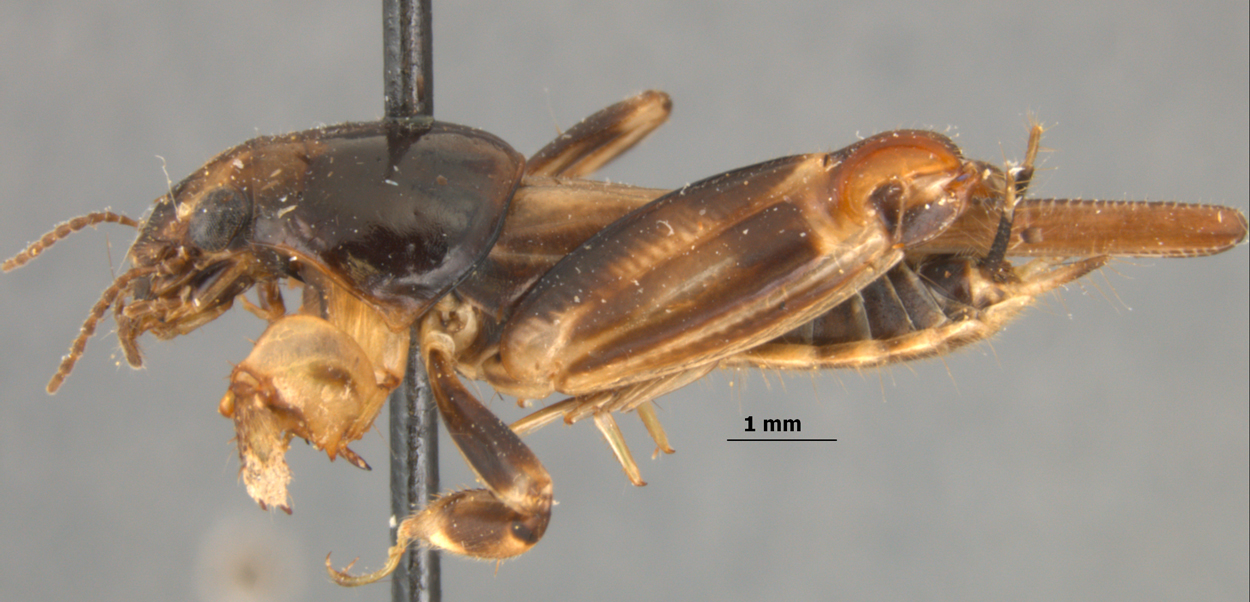
Image:http://mississippientomologicalmuseum.org.msstate.edu/images/Tridactylidae/Neotridactylis.apicallis.jpg
Subscribe to:
Posts (Atom)